Sealed, Stored, and Never Worn: Inside the Mind of the Yeezy Collector Who Refuses to Lace Up
There's a pair of 2016 Yeezy Boost 750s sitting in a climate-controlled room in suburban Atlanta. They've never touched pavement. The original tissue paper is still folded exactly the way it came from the box. The owner, a 34-year-old logistics manager named Derek, bought them for $350 at retail and hasn't seriously considered wearing them since the day they arrived. "At this point," he told us, "putting them on would feel like cracking open a first-edition book just to read it on the subway."
Derek isn't an outlier. Across the country, a specific breed of Yeezy enthusiast has quietly emerged — one whose relationship with footwear has less to do with fashion or function and almost everything to do with preservation, ownership, and something that starts to look a lot like curatorial pride. These are the vault builders. And their hobby is raising some genuinely uncomfortable questions about what sneaker culture has become.
When a Shoe Stops Being a Shoe
The shift didn't happen overnight. In the early days of Yeezy mania — roughly 2015 through 2017 — most people who camped out or refreshed SNKRS obsessively still intended to wear what they bought. The culture was loud, visible, on-foot. Flexing meant wearing, not displaying.
But as resale prices climbed and certain colorways started selling for multiples of retail, a different logic took hold. Deadstock condition became a financial asset. Wear meant depreciation. The box wasn't just packaging anymore — it was part of the artifact.
For collectors like Marcus, a 29-year-old in Chicago who owns over 40 pairs of Yeezys with fewer than a dozen worn, the turning point was specific. "I wore a pair of Zebras maybe three times, then saw what they were selling for and just... stopped. It felt irresponsible," he said. "Like driving a classic car in a hailstorm."
That car analogy comes up a lot in conversations with serious collectors. The idea that certain objects transcend their original utility and become something else — a symbol, a store of value, a cultural artifact — is familiar territory for anyone who collects vintage automobiles, rare vinyl, or original-run comics. Yeezys, for a certain type of enthusiast, have crossed that same threshold.
The Infrastructure of Obsession
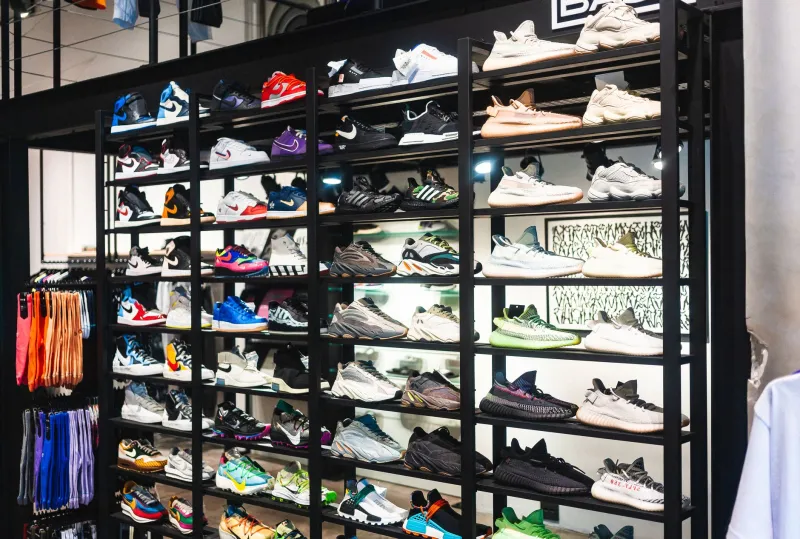
If you want to understand how seriously these collectors take preservation, look at their storage setups. We're not talking about a shelf in the closet. We're talking about dedicated rooms with UV-filtering acrylic display cases, portable air conditioners running year-round, silica gel packets rotated on a schedule, and in a few cases, purpose-built humidity control systems that wouldn't look out of place in a museum archive.
Tyrone, based in Houston, built out a spare bedroom specifically for his collection two years ago. The room holds 60-plus pairs, mostly Boost-era silhouettes, organized by colorway family and displayed in matching clear cases mounted to the wall. "My wife calls it the shrine," he laughed. "I call it an investment portfolio with better aesthetics."
The financial framing is real for him. Tyrone tracks his collection's estimated resale value the way some people track a stock portfolio — monthly check-ins on StockX and GOAT, notes on which colorways are trending up, a spreadsheet with purchase prices and current market comps. A few pairs he's held for four-plus years have more than tripled in value. "If I'd worn them, that's gone," he said simply.
But not everyone in the vault-builder community is purely motivated by money. For some, the preservation impulse runs deeper and gets harder to articulate cleanly.
The Emotional Math of Ownership
Ask a serious non-wearing collector why they bought sneakers they'll never put on, and the answers get interesting fast. There's pride of ownership — the satisfaction of having secured something rare, of being one of a small number of people who got a particular pair. There's the tactile pleasure of the unboxing ritual, which many describe in almost reverent terms. And there's something else: a kind of stewardship mentality, a sense that they're preserving a piece of design history that might otherwise get scuffed into oblivion.
"I think about the people who wore their original Air Jordan 1s in 1985," said Marcus. "Like, good for them, they got to experience those shoes. But also — none of those pairs exist in perfect condition anymore. Someone has to be the person who keeps them right."
That logic has a certain internal consistency. Sneaker museums like the one at the Bata Shoe Museum in Toronto, or the archives maintained by brands themselves, exist precisely because someone thought preservation mattered. Collectors like Marcus see themselves as part of that continuum — unofficial archivists of a design era they believe will be studied seriously someday.
Still, there's a tension here that even the collectors themselves acknowledge. Sneakers were designed to be worn. The Boost foam in a Yeezy 350 was engineered for a foot to compress it, for a body to feel that energy return. A shoe in a case experiences none of that. It just sits there, slowly off-gassing its adhesives, foam cells quietly degrading regardless of how perfect the storage conditions are.
Has the Hobby Eaten Itself?
Here's the uncomfortable question that the vault-builder phenomenon forces into the open: if the point of sneaker culture was originally about self-expression through what you put on your feet, what does it mean when the shoes never touch feet at all?
Some long-time sneakerheads are openly critical. "It's not sneaker culture anymore, it's just collecting," said one on-foot enthusiast we spoke to who's been in the game since the early 2000s. "There's nothing wrong with collecting. But let's not pretend it's the same thing."
That distinction — collector versus sneakerhead — is increasingly real. The communities overlap but don't fully align. One is oriented around wearing, styling, and the lived experience of the shoe. The other is oriented around acquisition, condition, and long-term value. Both camps exist within the Yeezy world, and both have legitimate claims to the culture.
Derek, back in Atlanta with his unworn 750s, doesn't lose sleep over the philosophical debate. "I know what I am," he said. "I'm a collector. I got into this because I love what Kanye built with this line — the design language, the cultural moment it represented. Keeping these in perfect condition is how I honor that. Other people can wear theirs. I'll keep mine."
He paused, then added: "Besides, the resale on 750s right now is stupid good. I'm not touching them."
Maybe that's the most honest answer anyone's given us. The vault effect is real, it's growing, and it's reshaping what Yeezy collecting looks like in 2024. Whether that's a natural evolution of the hobby or a slow drift away from its roots probably depends on which side of the display case you're standing on.